
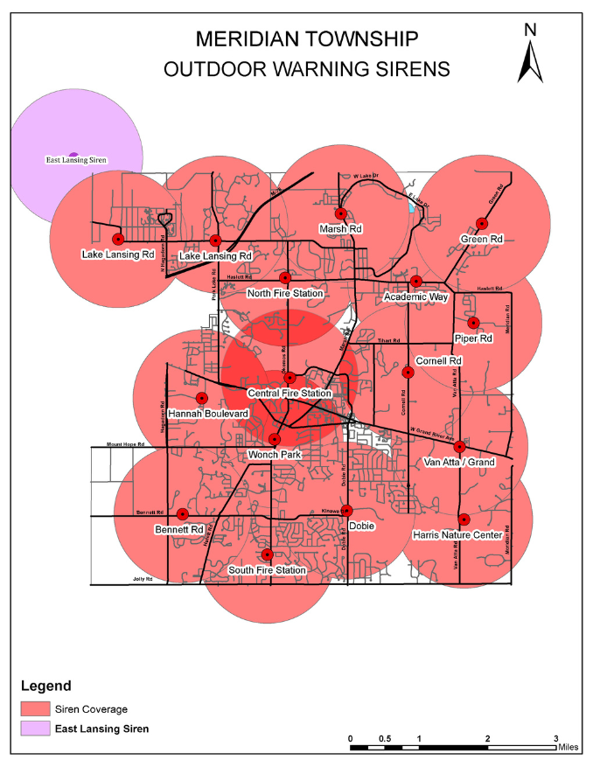
Outdoor warning sirens are used in emergency situations and, and 16 sirens can be found throughout Meridian Township. Each warning siren currently covers a 5,000 ft. radius.
Meridian Township Outdoor Warning Sirens Map (Updated October 2024)
Welcome to our new website! We hope you find it helpful and easier to navigate. For help, please contact webmaster@meridian.mi.us.
Outdoor warning sirens are critical for the safety of our residents during potential severe weather events.
Working with Ingham County 911 Center, warning sirens will sound for the following severe weather events:
Outdoor warning sirens are used in emergency situations and, and 16 sirens can be found throughout Meridian Township. Each warning siren currently covers a 5,000 ft. radius.
Meridian Township Outdoor Warning Sirens Map (Updated October 2024)
The Meridian Township sirens are tested at 1:00 pm on the first Saturday of each month.
The Ingham County 911 Center is responsible for sounding the sirens for testing and during an actual event when a warning is issued. The monthly test uses the standard “ALERT” (steady) sound and lasts 30 to 60 seconds.
This test confirms the reliability of each siren in Ingham County. The last thing we want is a siren that fails during a severe weather event.
The Meridian Township sirens are tested at 1:00 pm on the first Saturday of each month. The Ingham County 911 Center is responsible for testing the sirens and setting them off during an emergency. The monthly test uses the standard “ALERT” (steady) sound and lasts 30 to 60 seconds. This test confirms the reliability of each siren in Ingham County. The last thing we want is a siren that fails during a severe weather event.
If you are outside when the warning sirens activate, seek shelter immediately by moving inside. The best place for shelter is in a basement or an interior room.
Siren locations were chosen based on several factors, the most important being the ability to provide optimal, uniform coverage throughout the entire Township. These areas include high-population-density areas and outdoor gathering areas such as parks and lakes.
Other factors include southern exposure, elevation, proximity and height of adjacent structures, underground and overhead utilities, and accessibility for installation and maintenance. Most sirens are placed in the public right-of-way next to schools, parks, fire stations, and commercial and public facilities. However, in some neighborhoods, it was impossible to avoid placement near residences without having gaps in sound coverage.
In certain circumstances, the Township will consider moving sirens. However, moving sirens is costly and time-consuming, as there are only a few vendors in the country with the expertise to install the siren head, radio system, solar panels, batteries, etc. Having a siren move requires advanced budgeting, permitting, and scheduling. Additionally, moving a siren a block or two would do little to minimize the sound – sirens are meant to be loud!
Unfortunately, the National Weather Service (NWS) does not issue an all-clear after a tornado warning. Instead, each of their warnings carries a start and end time, so unless the warning is extended, reissued, or cancelled, it will simply expire at the end time. Therefore, it is essential to monitor local media or the NWS to stay informed of any changes.
We encourage schools, office buildings, and other large facilities to have their facility managers or safety personnel monitor the media, NOAA weather radio, or other reliable information sources and alert the facility tenants when the warning has passed.
Severe weather, in the form of thunderstorms, windstorms, floods and tornadoes, is a threat to the health and safety of all Michigan residents.
Here is what you should know before severe weather strikes:
For more information check out the following website: https://www.ready.gov/severe-weather
Contact Us
Staff
Mike Hamel
Fire Chief
hamel@meridian.mi.us
517.853.4704
Tavis Millerov
Fire Marshal
millerov@meridian.mi.us
517.853.4720
Brian Pennell
EMS/Training Chief
pennell@meridian.mi.us
517.853.4724
Christine Cassidy
Administrative Assistant II
cassidy@meridian.mi.us
517.853.4716